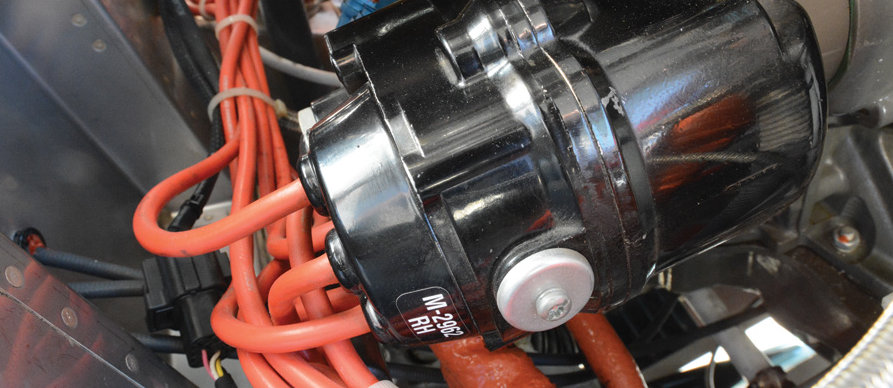
Magneto technology is more than 100 years old and can be found in everyday item ignition systems such as lawn motors, chain saws, and old tractors etc. They have remained a source of power in light aircraft because they are self-contained and not attached to battery or electric systems in the aircraft, allowing the engine to continue to run even during a battery or electrical failure.
Magneto Function
The function of the aviation piston engine ignition system is to provide an electrical spark to ignite the fuel/air mixture in the engine cylinders.
The ignition system of the engine is a separate system and is not part of the airplane’s overall electrical system. The magneto type ignition system is used on most reciprocating aircraft engines.
Magnetos are engine-driven self-contained units that supply electrical current without using an external source of current.
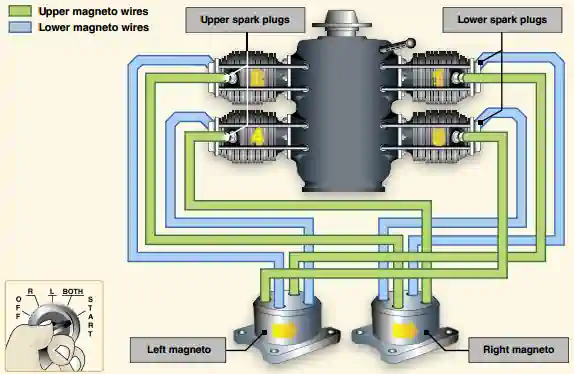
Modern airplane engines are required by to have a dual ignition system – that is, two separate magnetos to supply the electric current to the two spark plugs contained in each cylinder.
Historically the FAA has required that the ignition in aircraft be separate from the battery/electrical system, but newer and better-performing electronic ignition systems are gaining acceptance.
One magneto system supplies the current to one set of plugs, while the second magneto system supplies the current to the other set of plugs. The airplane’s double ignition system provides better performance because of more efficient combustion and a higher level of safety through redundancy.
Operation
In operation a magnet (hence magneto) spins in close proximity to a coil of wire. As the magnet spins (or the magnet rotor is turned), it generates a strong magnetic force that is “held back” by a primary coil.
The moment the contact points open, a rapid magnetic flow generates a high voltage in the secondary coil, which ignites the spark plug, thus firing the engine.
The two magnetos on most GA aircraft—the left and the right—each fire one of two spark plugs on each cylinder. There are two magnetos so that if one fails the engine continues to run, but will be less efficient.
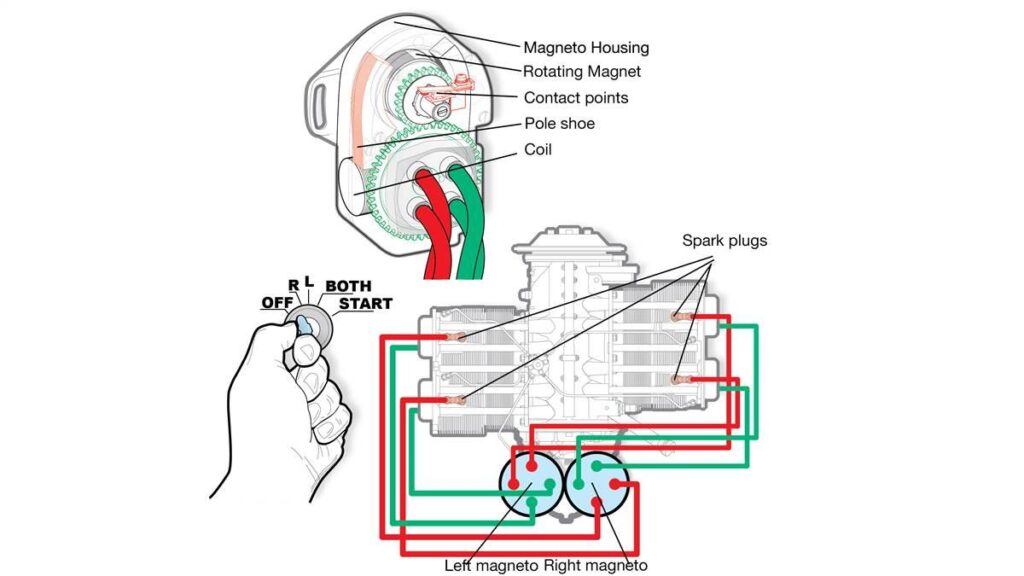
Note: The operation of the magneto is controlled in the flight deck by the ignition switch (as shown above.)
The switch has five positions:
- OFF
- R (right)
- L (left)
- BOTH
- START
With RIGHT or LEFT selected, only the associated magneto is activated.
The system operates on both magnetos when BOTH is selected.
P-LEAD
The “P” in P-lead stands for “Primary” (as in Primary coil winding within the magneto) winding lead. It is a shielded wire that connects the primary coil inside an aircraft magneto to the ignition switch.
While many electrical wires deliver power, the P-lead’s purpose is the opposite: it provides a grounding path to disable
or “kill” the magneto when required.
Magneto Checks in Flight Operations
A malfunctioning ignition system can be identified during the required pre-takeoff (run up) check.The pilot must check each magneto by turning the ignition switch key to LEFT and RIGHT individually.
While carrying out this check the pilot will observe a decrease in rpm that occurs when the ignition switch is first moved from “BOTH” to “LEFT” and then “BOTH” to “RIGHT”
- A small drop in RPM is normal (usually 50–150 RPM).
- A large drop or rough running could indicate a faulty plug, ignition lead, or magneto problem.
- If no RPM drop is observed during the magneto check, the pilot should suspect a hot magneto caused by a faulty or ungrounded P-lead and immediately report it to maintenance.
- Do not proceed with the flight.
- Until resolved, treat the engine as live at all times, even with the ignition switch OFF.
- Use extreme caution when moving around the aircraft, do not touch or rotate the propeller, as it could spark and cause the engine to fire unexpectedly. Alert all personnel and avoid any propeller movement until cleared by a mechanic.
The Firing Process
When the engine crankshaft turns:
- The rotating magnet sweeps past the coil, generating current.
- At the exact right timing (measured in degrees before top dead center), the breaker points open.
- Current stops flowing through the primary coil, collapsing the magnetic field.
- The sudden collapse induces a high-voltage surge in the secondary coil.
- This surge travels through the distributor to the correct spark plug.
- The spark ignites the fuel-air mixture in the cylinder.
Timing is critical—just a few degrees too early or late can cause rough running or engine damage.
Engine Shutdown and Safety Considerations
Following engine shutdown, always turn the ignition switch to the OFF position.
Even with the battery and master switches OFF, the engine can fire and turn over if the ignition switch is left ON and the propeller is moved because the magneto requires no outside source of electrical power.
Be aware of the potential for serious injury in this situation.
Even with the ignition switch in the OFF position, if the ground wire between the magneto and the ignition switch becomes disconnected or broken, the engine could accidentally start if the propeller is moved with residual fuel in the cylinder.
If this occurs, the only way to stop the engine is to move the mixture lever to the idle cutoff position, then have the system checked by a qualified AMT.