
Weather Minimums are the specified limits of weather conditions that must be met or exceeded for certain flight operations to be permitted. These minimums are critical for ensuring safe flight operations, particularly under Visual Flight Rules (VFR) and during instrument approaches.
Weather Minimums are critical benchmarks that refer to the specified limits of visibility, cloud ceiling, and other meteorological conditions that must be met or exceeded for aviation operations to be conducted safely.
Established by aviation regulatory authorities, these criteria are fundamental to flight planning and operations, particularly under Visual Flight Rules (VFR) and Instrument Flight Rules (IFR).
Weather minimums ensure that pilots have sufficient visibility and spatial orientation to navigate safely, both in the air and near the ground, during takeoffs, en-route flights, and landings.
Types of Weather Minimums
- VFR Weather Minimums: Specify the minimum visibility and distance from clouds required for VFR operations. These minimums vary depending on the airspace class, time of day, and whether the flight is conducted above or below 10,000 feet MSL (Mean Sea Level).
- IFR Weather Minimums: These are pertinent to instrument approaches and are defined for specific airport procedures. These include Decision Altitude (DA), Decision Height (DH), Minimum Descent Altitude (MDA), and visibility requirements that vary by approach type (e.g., ILS, RNAV, VOR approaches).
91.155 Basic VFR weather minimums.
(a) Except as provided in paragraph (b) of this section and § 91.157, no person may operate an aircraft under VFR when the flight visibility is less, or at a distance from clouds that is less, than that prescribed for the corresponding altitude and class of airspace in the following table::
| Airspace | Flight visibility | Distance from clouds |
|---|---|---|
| Class A | Not Applicable | Not Applicable. |
| Class B | 3 statute miles | Clear of Clouds. |
| Class C | 3 statute miles | 500 feet below. |
| 1,000 feet above. | ||
| 2,000 feet horizontal. | ||
| Class D | 3 statute miles | 500 feet below. |
| 1,000 feet above. | ||
| 2,000 feet horizontal. | ||
| Class E: | ||
| Less than 10,000 feet MSL | 3 statute miles | 500 feet below. |
| 1,000 feet above. | ||
| 2,000 feet horizontal. | ||
| At or above 10,000 feet MSL | 5 statute miles | 1,000 feet below. |
| 1,000 feet above. | ||
| 1 statute mile horizontal. | ||
| Class G: | ||
| 1,200 feet or less above the surface (regardless of MSL altitude) | ||
| For aircraft other than helicopters: | ||
| Day, except as provided in § 91.155(b) | 1 statute mile | Clear of clouds. |
| Night, except as provided in § 91.155(b) | 3 statute miles | 500 feet below. |
| 1,000 feet above. | ||
| 2,000 feet horizontal. | ||
| For helicopters: | ||
| Day | 1/2 statute mile | Clear of clouds |
| Night, except as provided in § 91.155(b) | 1 statute mile | Clear of clouds. |
| More than 1,200 feet above the surface but less than 10,000 feet MSL | ||
| Day | 1 statute mile | 500 feet below. |
| 1,000 feet above. | ||
| 2,000 feet horizontal. | ||
| Night | 3 statute miles | 500 feet below. |
| 1,000 feet above. | ||
| 2,000 feet horizontal. | ||
| More than 1,200 feet above the surface and at or above 10,000 feet MSL | 5 statute miles | 1,000 feet below. |
| 1,000 feet above. | ||
| 1 statute mile horizontal. |
Graphical Depiction of VFR Weather Minimums
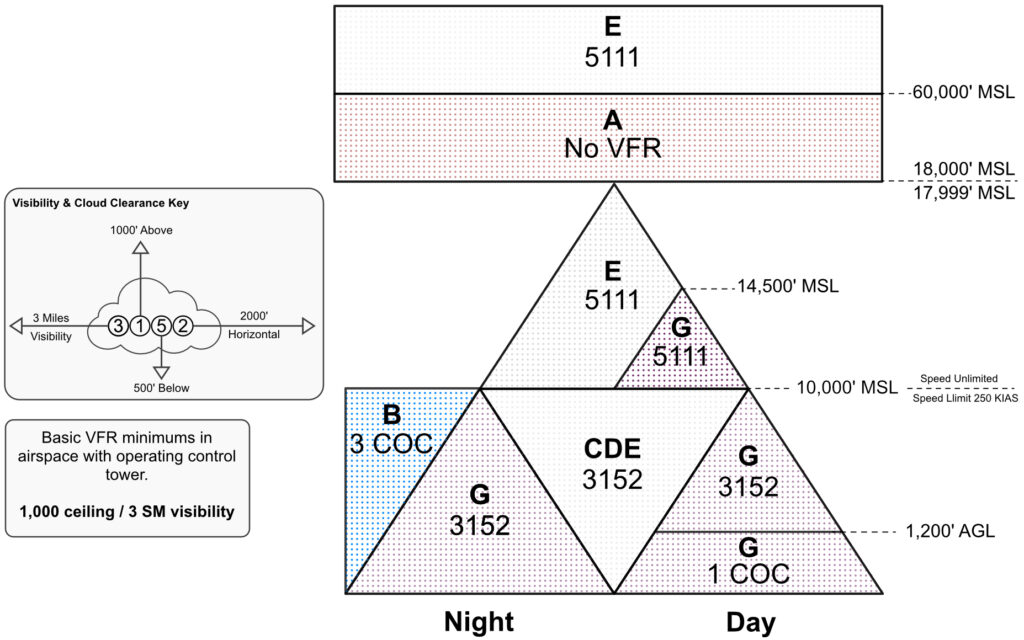
Basic VFR mins in airspace with operating control tower = 1,000′ ceiling / 3 SM visibility
Flight conditions
VFR = Ceiling greater than 3,000 feet and visibility greater than 5 miles; includes sky clear.
MVFR = (Marginal VFR) Ceiling 1,000 to 3,000 feet and/or visibility 3 to 5 miles inclusive.
IFR = Ceiling 500 to less than 1,000 feet and/or visibility 1 to less than 3 miles
LIFR = (Low IFR) Ceiling less than 500 feet and/or visibility less than 1 mile.
Note: METARs only cover within 5 NM of the airport. You have no idea what will happen the further you get away. This is especially true in mountainous terrain. You also need to maintain VFR cloud clearance in Class E airspace which starts at 700 or 1200 feet AGL. So if the cloud bases are at 2000 feet you have to fly at 1500 feet. No matter what the terrain is doing you have to stay 500 feet below the clouds so you can avoid descending IFR traffic.