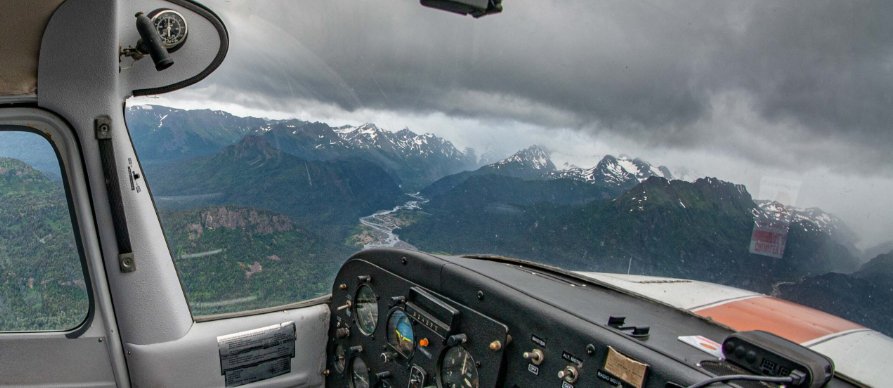
AIRMETs and SIGMETs are issued by the National Weather Service (NWS) when observed or forecast weather meets specific hazard criteria. They are disseminated to pilots through aviation weather briefings, flight-planning systems, and in-flight weather services.
- Airmen’s Meteorological Information (AIRMETs) Advises of weather phenomena that may affect the safety of light (and other) aircraft.
- Significant Meteorological Information (SIGMETs) Advises of weather advisories that may affect the flight safety for all aircraft.
AIRMET (Airmen’s Meteorological Information)
Advises of weather phenomena that may affect the safety of light aircraft and other aircraft, especially those operating under visual flight rules (VFR).
An AIRMET is an aviation weather advisory issued to warn pilots about moderate but potentially hazardous weather conditions that could affect aircraft safety – especially for smaller planes.
What an AIRMET covers
AIRMETs are issued by the National Weather Service and typically describe widespread conditions lasting several hours. They’re less severe than SIGMET alerts.
There are three main types of AIRMET:
- Sierra: IFR conditions and mountain obscuration.
- Tango: Moderate turbulence, sustained surface winds of 30 knots or greater, and non-convective low-level wind shear.
- Zulu: Moderate icing and freezing level information.
- AIRMET Sierra
Concerns IFR conditions (low visibility, low ceilings) and mountain obscuration
Issued when:- Ceilings below 1,000 ft
- Visibility below 3 SM
- Mountain obscuration
- Most important for ≥ 50% of the AIRMET area
- AIRMET Tango – Covers moderate turbulence, strong surface winds, and low-level wind shear
Issued for:- Light to moderate turbulence
- Surface winds ≥ 30 knots
- Low-Level Wind Shear (LLWS)
Can affect aircraft control and passenger comfort
- AIRMET Zulu – Focuses on moderate icing and freezing levels
Issued when:- Light to moderate icing is possible
SIGMET (Significant Meteorological Information)
Advises of more severe or particularly hazardous weather that may affect the safety of all aircraft.
Common examples:
- Severe or extreme turbulence.
- Severe icing.
- Dust storms or sandstorms that significantly reduce visibility.
- Volcanic ash clouds.
- Certain significant non-convective low-level wind shear conditions.
When are they issued?
- AIRMETs: Issued when conditions such as widespread IFR, mountain obscuration, moderate turbulence, or moderate icing meet advisory criteria. They are routinely updated as conditions change.
- SIGMETs: Issued when significant hazardous weather, such as severe turbulence, severe icing, volcanic ash, or qualifying dust and sandstorms, is occurring or forecast.
How long are they valid?
For the contiguous United States (CONUS), these are the standard periods:
| Advisory | Issuance schedule | Valid period |
|---|---|---|
| AIRMET text | Every 6 hours, plus unscheduled updates | Up to 6 hours |
| G-AIRMET (graphical) | Every 6 hours | Forecasts at 3-hour intervals, out to 12 hours |
| SIGMET (nonconvective) | Unscheduled, as needed | Up to 4 hours; certain tropical-cyclone advisories are valid for 6 hours |
| Convective SIGMET | Hourly, plus special issuances | Up to 2 hours |
Note: The validity period is not a guarantee that the weather will last that long. If hazardous conditions persist, the advisory may be updated and reissued. If the hazard ends, it may be canceled.
Checking for AIRMETs and SIGMETs
- Before flight: Check active advisories along your route and at your planned altitudes.
- During flight: Monitor updated weather information and relevant ATC or Flight Service advisories when available.
- Before an advisory expires: Don’t assume the hazard has ended. Look for updates, newer advisories, and current observations.
How are AIRMETs and SIGMETs disseminated?
Aviation weather websites
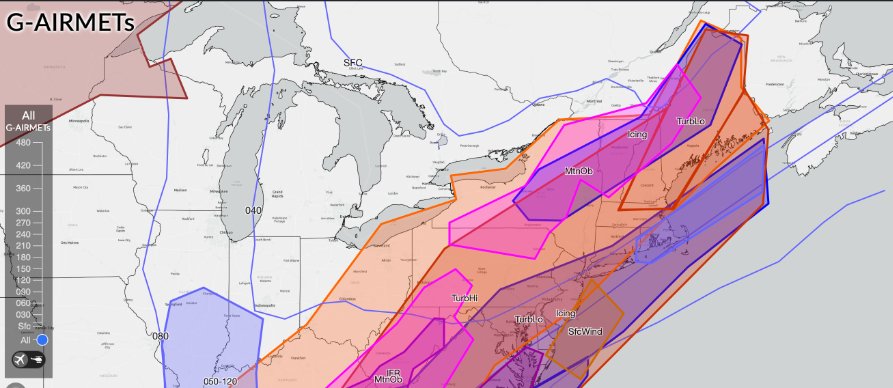
Pilots can view graphical advisories on the Aviation Weather Center website: aviationweather.gov.
Flight Service briefings

Pilots can obtain advisories through 1800wxbrief.com and Flight Service briefings, helping them assess hazards before departure.
In-flight data services
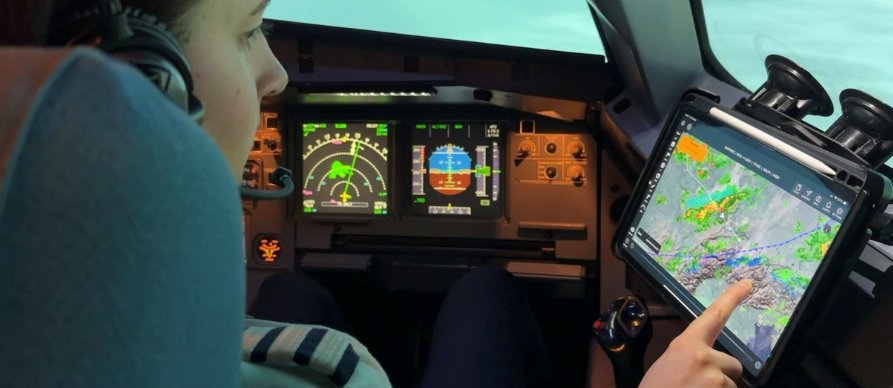
Aircraft equipped with compatible receivers can receive weather products through Flight Information Service–Broadcast (FIS-B), where available.
Compatible cockpit displays and electronic flight bags may also display downloaded or connected weather data.
ATC and radio broadcasts

Air traffic control facilities may broadcast alerts about significant advisories affecting nearby airspace and direct pilots to Flight Service for details.
In-flight advisory broadcasts depend on the advisory type, location, and applicable procedures.
What should a pilot remember?
AIRMETs and SIGMETs are advisories, not automatic flight prohibitions. Pilots must evaluate them along with other weather products and applicable regulations.
The main differences are the severity of the weather and the types of hazards covered.
- AIRMET: Adverse weather — conditions that warrant caution and may affect your planned flight.
- SIGMET: Significant weather — potentially serious hazards requiring careful consideration and often avoidance.
Example: If you’re planning a VFR flight in a Piper Warrior and an AIRMET warns of mountain obscuration, you might lose the visual references needed to navigate safely.
If a SIGMET warns of severe turbulence along your route, you would generally consider rerouting around the affected area.
- Before flight: Check active advisories along your route and at your planned altitudes.
- During flight: Monitor updated weather information and relevant ATC or Flight Service advisories.
- Before an advisory expires: Don’t assume the hazard has ended. Look for updates, newer advisories, and current observations.
For the FAA knowledge test purposes, the key numbers to remember are AIRMET: 6 hours; SIGMET: 4 hours; Convective SIGMET: 2 hours, with the special cases noted above