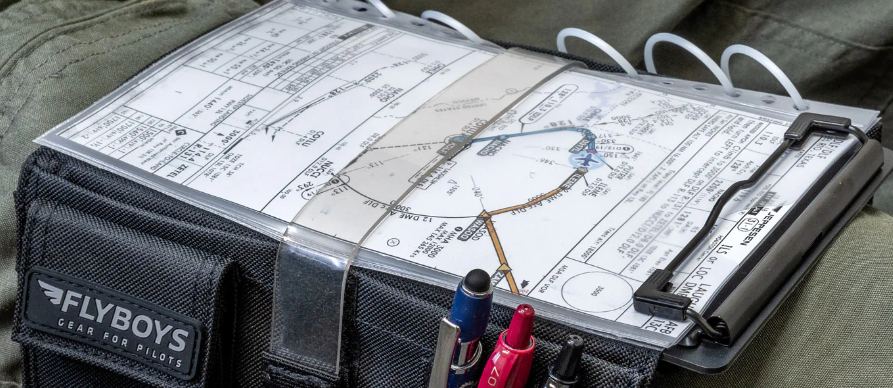
A kneeboard is a small, strap-on clipboard worn on the thigh that lets you secure a notepad, charts, and reference materials while flying. It’s designed for quick access in a cramped cockpit where you often don’t have a free hand or stable surface.
A kneeboard isn’t strictly required, but for a student pilot it’s one of the simplest tools to improve situational awareness, accuracy, and cockpit workflow. It essentially acts as your “mission control panel” on your leg.
What it typically includes
- A writing surface (clipboard or fold-out panel)
- Elastic straps to secure it to your leg
- Holders for pens/pencils
- Sometimes sleeves for checklists, approach plates, or a tablet (like an iPad)
Why you need to use a kneeboard
Makes radio communication easier
When ATC gives you instructions (e.g., taxi routes or clearances), you can write them down immediately. This is crucial because student pilots often miss or forget parts of long transmissions.
Reduces cockpit workload
As you begin and advance in your training as a pilot, you’re juggling aircraft control, radio calls, navigation, and instructor input. A kneeboard keeps critical info in one place so you’re not fumbling for papers.
Improves organization
You can pre-load:
- Checklists
- Frequencies
- Flight Plans / Navigation logs
This prevents missed steps and helps build disciplined cockpit habits early.
Keeps your eyes where they belong
Instead of looking around the cockpit or down at your lap, the kneeboard keeps information in a consistent, predictable location—reducing distraction.
Builds real-world habits
Kneeboards are widely used in general aviation and even by professional pilots. Learning to use one early helps you transition smoothly to more complex flying.
When it matters most
- Busy airspace or controlled airports
- Training phases involving navigation and ATC interaction
- Cross-country flights
Choosing a kneeboard
Making a good choice in your kneeboard purchase can be the difference between a good experience and a poor one. Many kneeboards are simply a small clipboard that holds a notepad or paper charts and offers no other functionality. While this is fine if you only ever want to use the kneeboard to write notes, clearances and other information down on, you may want to consider a kneeboard that will allow future expansion as needs and requirements change.
These types of kneeboards allow student pilots to begin getting used to wearing a kneeboard and begin writing down taxi instructions and other clearances from ATC when beginning their training.
There are many types of kneeboard (such as FlyBoys / Pivot system) that can adapt to the pilot’s changing requirements. This means they can be used initially for holding a paper based notepads etc then to holding approach plates and then to holding an Electronic Flight Bag (EFBs) such as an iPad.
Paper/Notebook Mode:
The kneeboards use the standard plastic clipboard to hold notes or charts, secured via the clear PVC retention strap.
Hybrid Mode:
The kneeboard can be used allowing the user to attach a paper pad to the hook-and-loop surface or simply use the leg mount as a flat surface for note-taking.
Electronic Mode:
The compatible kneeboard case connects to the kneeboard system, providing a secure, rotating mount for an iPad to be used as an Electronic Flight Bag (EFB)
Buying a kneeboard
You can find kneeboards on line at sites such as
- Flyboys / Pivot System www.flyboys.com,
- Sportys www.sportys.com ,
- Battleboard www.battleboard.com
- Pilot Mall www.pilotmall.com
- Amazon amazon.com
You can purchase a kneeboard that holds a notepad at East Coast Aero Club