The 3:1 rule is a simple way to estimate the descent rate needed for an airplane to reach a target altitude during a descent, for flights conducted under Visual Flight Rules (VFR).
The 3:1 rule is commonly used for planning descents to make sure you arrive at your desired altitude with a safe margin for maneuvering.
Here’s how the 3:1 rule works:
For every 3 nautical miles (NM) of horizontal distance, you need to descend 1,000 feet in altitude.
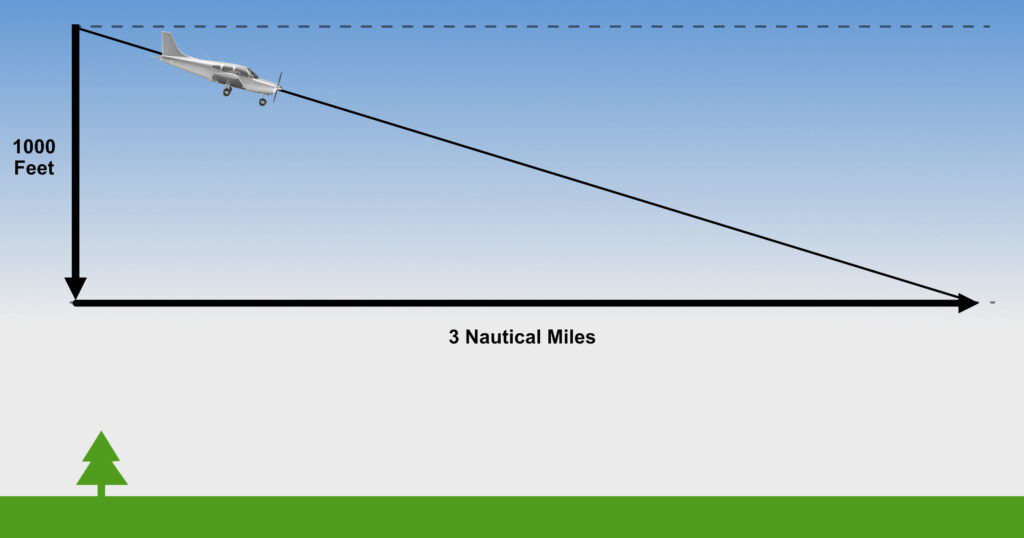
By calculating and flying the required VFR descent rate using the 3:1 rule we ensure that we are flying safely, within the aircrafts limitations and in a professional manner. This ensures that required altitudes are met in a timely manner and takes the guess work out of when a descent should begin and at what rate the aircraft needs to descend at. This involves applying some basic math and rules of thumb to determine the appropriate descent point and descent rate .
Calculations
Distance to descend calculation
To calculate the distance required to descend from your current altitude to the intended altitude using the 3:1 rule use the following calculation method.
altitude to descend / 1000 x 3
Example 1:
You are cruising at 6500’ MSL and require to descend to traffic pattern altitude of 1,000’ MSL. Where should you begin your descent? (Top of Descent)
6500’ descending to 1000’ = a required descent of 5,500’
5500 / 1000 = 5.5
5.5 x 3 = 16.5
Therefore to fulfill the 3:1 rule you would need to commence your descent 16.5 miles from the point you need to be at traffic pattern altitude (in this case 1000’ MSL)
Example 2:
When entering a class D airspace from the practice area(s)
- ECAC pilots wishing to re-enter the class D airspace will contact the Hanscom ATC tower at about 10 miles from the airport at 2,500’ MSL
- If the traffic Pattern Altitude is 1,200’ MSL (e.g Hanscom Airport)
- Therefore we have 1,300’ of altitude to descend to arrive at the required traffic pattern altitude.
- To achieve this we must figure out when to begin our descent.
- The math in this case will be 1,300 / 1000 x 3
- 1,300 / 1000 = 1.3
- 1.3 x 3 = 3.9
So to arrive at the traffic pattern altitude we must begin our descent 3.9 miles* from the point we need to be at traffic pattern altitude.
Note that the tower controller may give you instructions that may not allow the descent to be a 3:1 descent – requiring an earlier or later descent.
Rate of descent calculation
We need to calculate decent rate based off our ground speed in order to descent at the required rate for the 3:1 descent rate. This can be easily calculated using an E6B or using a GPS unit in flight.
Method 1:
Divide the ground speed by 2 and add 0
Example 1:
The calculated / actual ground Speed is 100 kts
100 / 2 = 50
50 add a zero for — 500 (fpm)
Therefore for a ground speed of 100 kts you would need to descend at 500 ft per minute
Example 2:
The calculated / actual ground Speed is 120 kts
120 / 2 = 60
60 add a zero for — 600 (fpm)
Therefore for a ground speed of 120 kts you would need to descend at 600 ft per minute
Method 2:
Multiply the ground speed by 5
Example 1:
The calculated / actual ground Speed is 100 kts
- 100 x 5 = 500
Therefore for a ground speed of 100 kts you would need to descend at 500 ft per minute
Example 2:
The calculated / actual ground Speed is 120 kts
120 x 5 = 600
Therefore for a ground speed of 120 kts you would need to descend at 600 ft per minute
The 3:1 rule is a simple way to estimate the descent rate needed for an airplane to reach a target altitude during a descent, especially in Visual Flight Rules (VFR). It is commonly used for planning descents to make sure you arrive at your desired altitude with a safe margin for maneuvering.
Here’s how the 3:1 rule works:
For every 3 nautical miles (NM) of horizontal distance, you need to descend 1,000 feet in altitude.
Formula:
Descent Rate (in feet per minute)=Altitude to lose (in feet)Distance to the destination (in nautical miles)×Groundspeed (in knots)Descent Rate (in feet per minute)=Distance to the destination (in nautical miles)Altitude to lose (in feet)×Groundspeed (in knots)
Or more simply:Altitude loss=Distance to target×300Altitude loss=Distance to target×300
This means for every 3 miles of horizontal distance, you descend 1,000 feet, or 300 feet per mile.
Notes :
The 3:1 rule is an approximation to make descent planning easier.
Always adjust for factors like wind and terrain to ensure a safe approach.