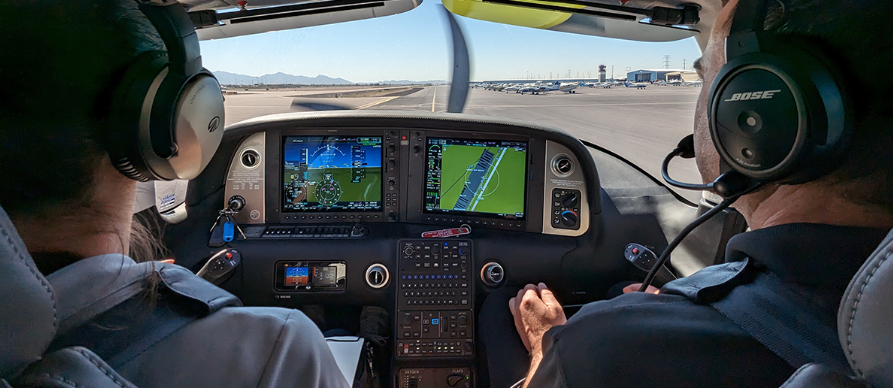
The flight review, (formerly know as the Biennial Flight Review (BFR) ), must be completed by all pilots every 24 month to ensure ongoing proficiency. Note: If you have completed an FAA Practical Test (check ride) within the past 24 months, you don’t need to complete a flight review until 24 months after the check ride.
The flight review required by Title 14 of the Code of Federal Regulations (14 CFR) 61.56 with the purpose of ensuring that all pilots receive a regular evaluation of piloting skills and aeronautical knowledge.
The flight review must consist of at least..
§ 61.56 Flight review.
(a) Except as provided in paragraphs (b) and (f) of this section, a flight review consists of a minimum of 1 hour of flight training and 1 hour of ground training. The review must include:
(1) A review of the current general operating and flight rules of part 91 of this chapter; and
(2) A review of those maneuvers and procedures that, at the discretion of the person giving the review, are necessary for the pilot to demonstrate the safe exercise of the privileges of the pilot certificate.
One hour of ground / oral review
Expect to review Regulations, Weather, ADM, Risk Management, etc
- The specific topics can be chosen for maximum benefit.
- Topics should be the most relevant to each individual pilot.
- The checklists in the appendices of AC 61-98E provide a good starting point.
During the oral review expect to cover practical knowledge of recommended procedures and regulatory requirements in the areas of (but not limited to)
- Aircraft systems
- Speeds
- Performance
- Meteorological and other hazards
- Operations in controlled airspace
- Abnormal and emergency procedures
Other subjects that may be included in your flight review in an effort to address and reduce accident and incident trends.
- Pilot deviations
- Spend time on pilot deviation avoidance awareness and best practices in avoiding deviations
- Automation competency
- Defined as the pilot’s ability to understand and operate a given aircraft’s automated systems
- Consider what automated systems your customer uses and come up with a plan to evaluate their proficiency using these systems
- Angle of Attack (AOA) systems
- Heavily promoted by the FAA and the General Aviation Joint Steering Committee (GAJSC) to reduce loss of control accidents
- Loss of control is
- Often the end result of a failure in risk management
- The number one immediate cause of fatalities
- If the airplane used in the review
- Has an AOA indicator
- Evaluate how your customer interprets and uses its cues
- Ensure that they know how to use the AOA correctly
- Does not have an AOA indicator
- Emphasize the importance of angle of attack
- Evaluate your customer’s general knowledge of aerodynamic principles relating to AOA
- Has an AOA indicator
- Abnormal and emergency procedures applicable to the aircraft
One hour of flight training
Maneuvers, procedures like slow flight, stalls, unusual attitudes) with a Certified Flight Instructor (CFI).
- FAR 61.56 sets out the maneuvers that needs to be accomplished – the choice is left with the CFI because..
- The flight should be conducted for the most benefit for each individual pilot
During the flight portion, regardless of your experience or background, there will be an evaluation on those maneuvers that are critical to flight safety, such as
- Takeoffs
- Stabilized approaches and landings
- Slow flight
- Stall recognition, stalls, and stall recovery
- Spin recognition and avoidance
- Recovery from unusual attitudes
- Operating the aircraft solely by reference to instruments under actual or simulated conditions
Flight reviews use the appropriate Airman Certification Standards (ACS) (e.g., private standards for private pilots, commercial standards for commercial or ATP pilots) as the standard of performance, because:
- You as a pilot have had to meet these standards at one time
- They’re objective
- They’re industry accepted
It is important to remember that the flight review is a training event, not a test, focusing on safe operations, updating skills, and familiarizing pilots with recent changes in rules and technology to maintain currency.
AC 61-98E (below) states that the flight review is also intended to offer pilots the opportunity for a personal currency and proficiency program in consultation with a certificated flight instructor (CFI).
Think of the flight review is the aeronautical equivalent of a regular medical checkup and ongoing health improvement program.
Advisory Circular
Flight Review Preparation
- Review Part 91 of the FARs
- There is an excellent course provided by the FAASTeam that can help you to prepare for the flight review, ALC-25: Flight Review Prep Guide
- This course breaks the regulations down according to the 4 parts of PAVE – Pilot, Aircraft, enVironment, External pressures
- There is an excellent course provided by the FAASTeam that can help you to prepare for the flight review, ALC-25: Flight Review Prep Guide
- Review your cross country planning skills in advance
- You may be asked how you prepare for cross country flights during the flight review.
- This will not be done in advance of the flight review as it will not give an accurate picture of the process you use to plan a flight
- The process itself is as important as the results
- Review the materials listed below.
Review Materials
Before attending a flight review you should review the following references where applicable.
- The applicable Airman Certification Standards (ACS)
- Aeronautical Information Manual (AIM)
- Airplane Flying Handbook
- Instrument Flying Handbook
- Instrument Procedures Handbook
- Information for Operators (InFO) 15012, Logging Instrument Approach Procedures (IAP)
- AC 60-28B, FAA English Language Standard for an FAA Certificate Issued Under 14 CFR Parts 61, 63, 65, and 107
- AC 61-65K, Certification: Pilots and Flight and Ground Instructors
- AC 61-89E, Pilot Certificates: Aircraft Type Ratings
- AC 61-136B, FAA Approval of Aviation Training Devices and Their Use for Training and Experience
- AC 91-73B, Part 91 and 135 Single Pilot, Flight School Procedures During Taxi Operations