
There are many factors that needs to be considered for the safe and efficient operation of aircraft, including proper weight and balance control. The weight and balance of an aircraft are crucial factors in aviation safety and performance, as they directly influence the aircraft’s flight dynamics.
Aircraft weight and balance refers to the process of calculating:
- An aircraft’s total weight and
- Determining the location of its center of gravity (CG) to ensure it remains within safe operating limits.
Every aircraft has a maximum takeoff weight and maximum landing weight.
Exceeding these limits can over-stress the structure, leading to potential damage or failure.
Determining the airplane’s weight and center of gravity prior to flight is crucial for understanding the loading of the airplane and maintaining stability and performance, as improper loading can lead to dangerous conditions like nose-heaviness or a loss of stall recovery capability.
Improper loading decreases the efficiency and performance of an aircraft from the standpoint of altitude, maneuverability, rate of climb, and speed. It may even be the cause of failure to complete the flight or, for that matter, failure to start the flight.
Because of abnormal stresses placed upon the structure of an improperly loaded aircraft, or because of changed flying characteristics of the aircraft destruction of valuable equipment or loss of life may result.
All pilots must understand and comply with the weight and balance limits of the aircraft they are flying in. Consequently you must be able to explain the following concepts:
- How to compute Weight and Balance,
- The effects of the airplane being outside of the center of gravity “envelope”.
- The dangers of being the airplane being over weight limitations set by the manufacturer.
- Effects the weight has on performance.
- How to weight and balance effects airplane maneuvering characteristics
- How to compute takeoff, landing, and cruise performance
- Actions that must be taken when the airplane is outside of the weight and balance limitations.
Pre-flight Preparation
Weight and balance computations should be part of every preflight planning process and briefing. Proper calculations allow the pilot to understand the loading and center of gravity of the aircraft so it can be flown safely within the manufacturers specifications and utilized to its fullest potential.
Pilots who fail to plan for the airplane’s weight and balance are not exhibiting good judgment and may violate 14 CFR 91.103 (preflight action).
Calculating Weight and Balance.
Equipment
In order to calculate an aircraft’s weight and balance some basic equipment and information is required
- Manufacturer’s Pilot Operating Handbook (POH)
(Note: Each individual airplane has its own specific POH on board the aircraft with the data recorded in the weight and balance record, that is specific for that particular airplane) - Electronic calculator
- Piece of paper (to perform the calculation)
- An understanding of Weight and Balance Key Concepts
Weight
Before commencing any flight you must determine the total weight of the aircraft and everything that has been added to it (fuel, baggage, pilot / passengers etc). This is to ensure that the maximum weight permissible for the aircraft is not exceeded and then subsequently to calculate the distribution of the weight throughout the aircraft to ensure that the aircraft balance is within the published center of gravity (CG) limits.
Start by creating a simple table on the piece of paper (or in a spreadsheet), such as the example table below.
Add columns for Weight / Arm / Moment
In the item column, add a row for each item and list the item. In the next column, using the information provided by the manufacturer and knowledge of passenger / luggage weights enter the known weight of the listed item. (note: 100LL AvGas = 6lb per gallon)
in order to determine that the permissible weight parameters that are allowable has not been exceeded.
- Enter the Empty Weight of the aircraft (in this case – 1,550 lbs)
add (or subtract) all other items to (or from) this known aircraft weight on subsequent lines. - Pilot and Front Passenger. (weight in lbs) (in this case – 340 lbs)
- Rear Passengers (weight in lbs – if any passengers) (in this case – 100 lbs)
- Baggage (In designated baggage area) (in this case – 50 lbs)
- Fuel (in this case – 288 lbs) – (100LL AvGas = 6lb per gallon)
- Calculate the total weight of the aircraft and all added items (in this case – 2643 lbs)
It is important to note that this is the Total Weight of the aircraft and all items loaded into the aircraft – before starting the engine and beginning to burn fuel.
| Item | Weight (lbs) | Arm (inches) | Moment (lb·in) | ||
|---|---|---|---|---|---|
| Aircraft Basic Empty Weight | 1550 | 132,990 | |||
| Pilot & Front Passenger | 340 | ||||
| Rear Passengers | 100 | ||||
| Baggage Area | 50 | ||||
| Fuel (full = 48 gal × 6 lbs/gal = 288 lbs) | 288 | ||||
| Ramp Weight Weight | 2328 | ||||
| Fuel Allowance For Engine Start, Taxi and Run Up | |||||
| Takeoff Weight (2440 Lbs. Normal, 2020 Lbs. Utility Maximum) |
If at this point the weight is heavier than the manufacturers maximum allowable weight for the aircraft you must reduce the weight. This can be achieved by:
- Removing Passengers
- Removing Luggage
- Draining fuel (or refueling to a known amount)
An overloaded aircraft may not be able to leave the ground, or if it does become airborne, it may exhibit unexpected and unusually poor flight characteristics.
Excessive weight also reduces the safety margins available to the pilot. Performance deficiencies of an overloaded aircraft include:
- Takeoff and Landing Distance: Higher takeoff speed and a longer takeoff / landing roll (increases the runway length needed for takeoff and landing)
- Reduced rate and angle of climb – Extra weight reduces climb performance
- Lower maximum altitude (i.e., service ceiling)
- Shorter range (Burns more fuel)
- Reduced cruising speed
- Reduced maneuverability
- Higher stalling speed
- Higher approach speed and longer landing roll
- Excessive weight on the nose-wheel or tailwheel
Note: Most modern aircraft are so designed that, when all seats are occupied, the baggage compartment is full, and all fuel tanks are full, the aircraft is grossly overloaded. This type of design requires the pilot to give great consideration to the requirements of each specific flight. If maximum range is required, occupants or baggage must be left behind, or if the maximum load must be carried, the range, dictated by the amount of fuel on board, must be reduced.
Balance
Airplanes are sensitive to where the weight is distributed within the aircraft and affects the balance of the airplane. This balance is defined in terms of the Center of Gravity (CG) of the airplane.
Center of Gravity (CG): The CG is the point where the airplane’s weight is evenly balanced. This is the exact point where the airplane’s total weight is considered to act— the balance point of the entire aircraft.
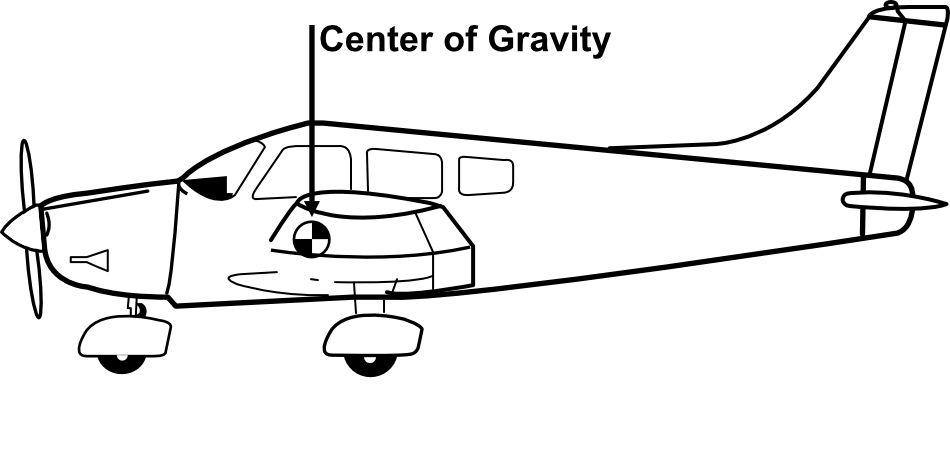
Imagine the airplane is hanging from a chord or a string – if the airplane was suspended at the CG (above) – this is the point where the airplane would balance and stay perfectly level.
Depending on how much weight is loaded onto the aircraft and where that weight is located can change the center of gravity (balance point) of the aircraft.
Airplanes in flight rely on their flight control surfaces to produce sufficient forces to maneuver and control the airplane. Large imbalances in weight distribution can lead to situations where the airplane is excessively nose heavy, or tail heavy, or wants to roll one direction or another.
The Center of Gravity is the key factor that determines stability, control, and safety in flight.
It is therefore extremely important to ensure that prior to flight the aircraft is within the CG limits (and maximum weight limits) as specified by the manufacturer of the aircraft.
The CG limits are published in the AFM / POH.
These values apply to all airplanes of the same model unless an airplane is later modified, for example, by a Supplemental Type Certificate.
The weight and balance data for privately owned and operated aircraft remains valid unless
(1) any item on the equipment list is removed,
(2) a new piece of equipment is permanently installed, or
(3) the aircraft undergoes an alteration that affects its weight.
If one of these conditions is met, the equipment list is revised, if applicable, and the new data is recorded in the weight and balance record.
Any loading that exceeds the established limitations can seriously impair the controllability and performance of the aircraft.
The primary concern in balancing an aircraft is the fore and aft location of the CG along the longitudinal axis.
The Pilot in Command (PIC) of a flight is responsible for ensuring that the airplane is properly loaded and within the CG limits before each flight.
Why the Center of Gravity Matters
Exceeding the forward or aft CG limit may render the airplane uncontrollable.
- If the CG is too far forward, the airplane may be nose-heavy, making it hard to climb or land safely.
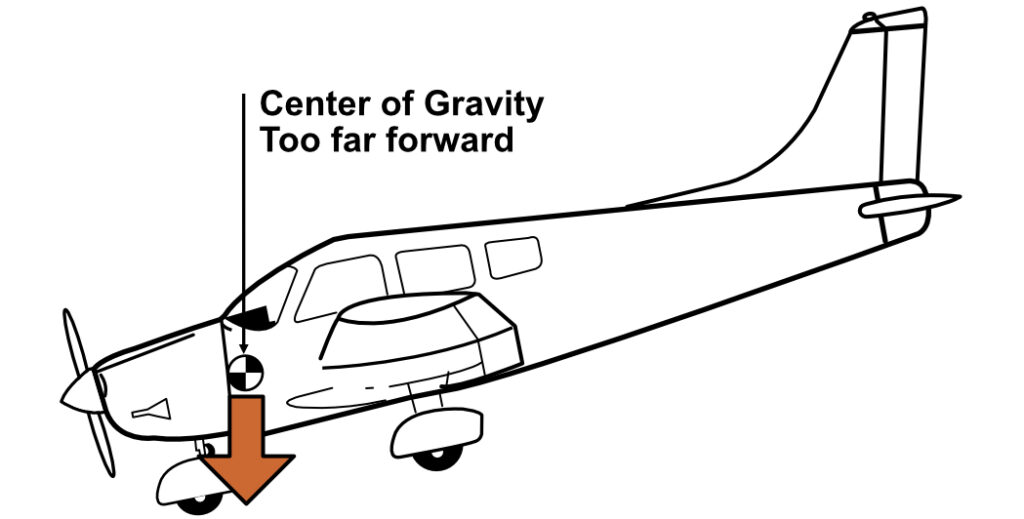
- Longer Takeoff Roll Because the weight is concentrated forward in the aircraft, it will need to gain more airspeed before it is able to reach liftoff speed.
- Longer Landing Roll The forward weight will create momentum in pulling the aircraft down the runway. Also, there won’t be as much weight over the main wheels so braking will be less effective.
- Higher Stall Speed The aircraft will stall at a higher airspeed due to “wing loading.” The wings will seem to be carrying more weight and will need to fly at a higher airspeed to produce enough lift to carry the additional feel of weight.
- Easier Stall Recovery The forward CG will assist the aircraft in recovering from a stall.
- Decreased Cruise Speed Because the CG is forward, the pilot will need to trim the aircraft “nose-up” to maintain altitude at cruise. The deflected trim tab will cause drag with the relative airflow.
- If the CG is too far aft (back), the airplane can become tail-heavy, reducing stability and risking a stall or spin.
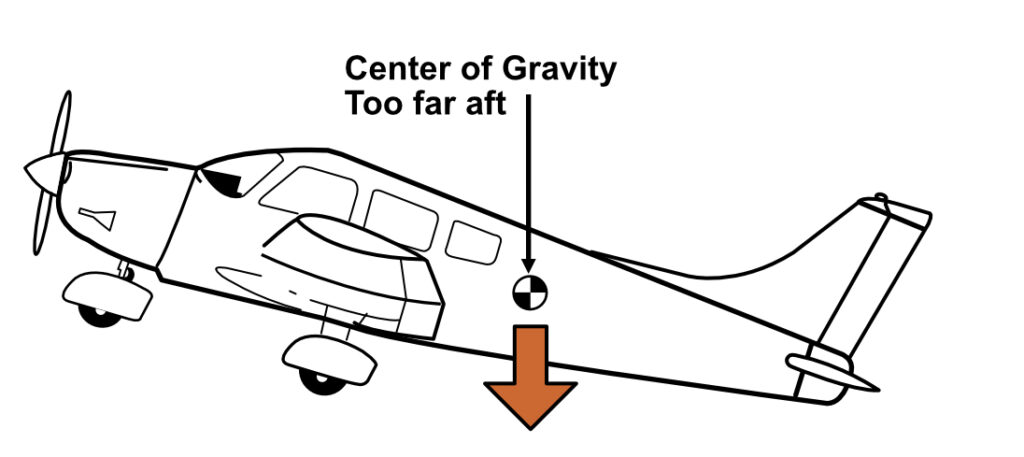
- Lower Stall Speed With the CG Aft, the aircraft will have a lower stall speed due to decreased wing loading.
- Reduced Elevator Authority The Aft CG will cause the Elevator and Rudder to be less effective. This is because the arm from the CG to the Elevator and Rudder is shorter.
- More Difficult Stall Recovery Because the weight is concentrated aft in the aircraft, it will be more difficult to lower the Angle of Attack in order to recover from a stalled condition.
- Faster Cruise Speed The Aft CG will not cause the Trim Tab on the Elevator to be deflected as far. Creating less drag at cruise.
Determining the Center of Gravity
In order to determine the center of gravity we will need to understand some key terms (and then do some math)!
Datum
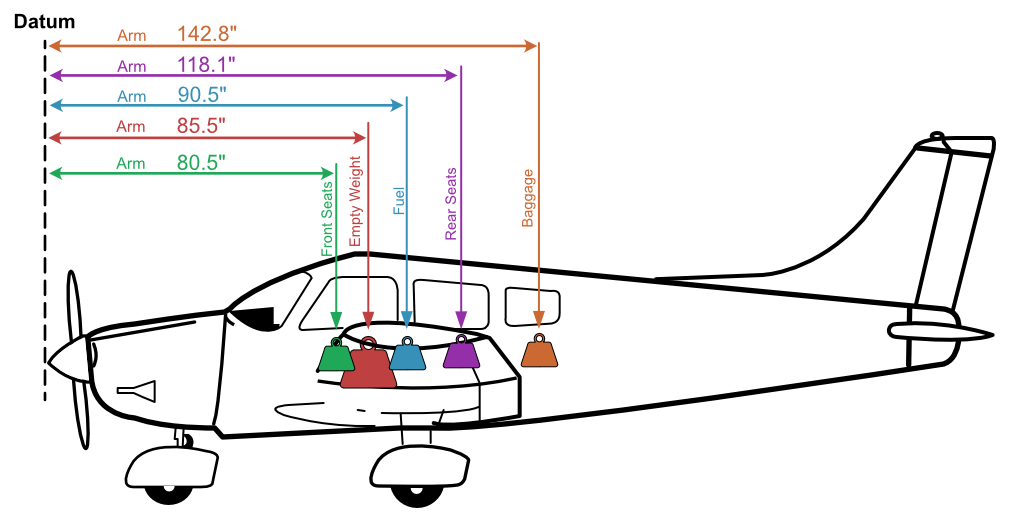
- The Datum is a designated reference point on the aircraft, often located at the firewall or at the tip of the spinner in the case of a Piper Warrior (see image below), from which all distances are measured.
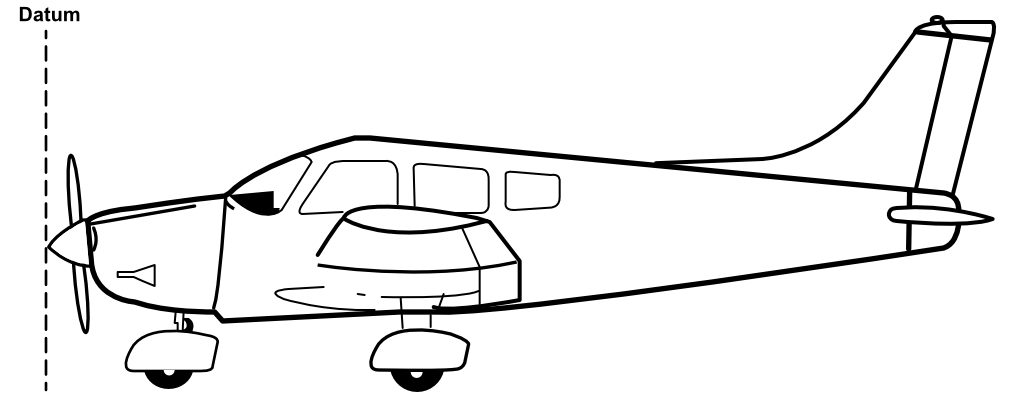
The official datum on a Piper Warrior is 78.4 inches ahead of the wing’s leading edge, at the intersection of the straight and tapered wing sections. Although some sources mention the tip of the spinner as a common or simplified reference, the official, certified datum is the fixed point 78.4 inches forward of the wing leading edge, which is used for all official weight and balance calculations.
Weight
- The total weight of the aircraft and its contents, (which must not exceed the maximum gross weight)
- Each item that is loaded on to the airplane must be considered and calculated in the weight and balance (see image below)
- Each item that is added is said to be located at a “Station“. A station is a defined point in the airplane for example. Pilot and Front seats, Rear Passenger Seats, Fuel Tanks, Luggage compartment.
Arm
- The Arm defines the distance each station is located from the datum. (see image below)
- This horizontal distance from the datum to the center of a station or object loaded onto the aircraft (e.g., a passenger’s seat, a fuel tank) is known and the “Arm” and is
- An Arm is generally expressed in inches.
- The Arms for a Piper Warrior are as follows.
Moment
- A Moment is the product of an item’s weight multiplied by its arm ie. Weight × Arm = Moment.
- Moments are expressed in pound-inches (in-lb).
- Total moment is the total of all of the item moments added together
- To find the center of gravity – divide the total moment by the weight of the airplane.
- Total Moment ÷ Total Weight = Center of Gravity
Weight and Balance Determination for Flight
- Enter each item to be loaded onto the aircraft and it’s weight to the weight and balance table (see table below)
- Front Seats (Pilot / Co-Pilot Passenger)
- Rear Seats (Passenger(s))
- Baggage
- Fuel
- Add up the weight of all items to be loaded onto the aircraft with the basic empty weight of the aircraft.
- This will give you the “Ramp Weight” (the weight before you begin to burn fuel)
- Add the Arm for each station to the weight and balance table. (see table below)
- Aircraft Basic Empty Weight = 85.5
- Pilot & Front Passenger = 80.5
- etc
- Calculate the moment for each item loaded onto the aircraft (Moment = Weight x Arm)
- Moment for Aircraft Basic Empty Weight : 1550 x 85.5 = 132,990
- Moment for Pilot & Front Passenger : 340 x 80.5 = 27,370
- etc
- Once all of the moments have been calculated, add all of the moments together (for of all items in the table)
- Total Moments = 202,154
- Divide the total moment by the total weight to determine the C.G. location.
- 202,154 ÷ 2288 = 88.3
- Once you have all Item Weights and Arms for the aircraft, each moment can calculated
- Fill in all of the Arms for each station
- Calculate the Moment for each item (Weight × Arm = Moment)
| Item | Weight (lbs) | Arm (inches) | Moment (lb·in) | ||
|---|---|---|---|---|---|
| Aircraft Basic Empty Weight | 1550 | x | 85.5 | = | 132,990 |
| Pilot & Front Passenger | 340 | x | 80.5 | = | 27,370 |
| Rear Passengers | 100 | x | 118.1 | = | 11,810 |
| Baggage Area | 50 | x | 142.8 | = | 7,140 |
| Fuel (full = 48 gal × 6 lbs/gal = 336 lbs) | 288 | x | 90.5 | = | 26,064 |
| Ramp Weight Weight | 2328 | 205,374 | |||
| Fuel Allowance For Engine Start, Taxi and Run Up | |||||
| Takeoff Weight (2440 Lbs. Normal, 2020 Lbs. Utility Maximum) |
Takeoff Weight and Balance
Between the time you have loaded the aircraft and starting the engine / taxi / run-up to taking off, the weight and balance of the aircraft will change. This is because as soon as you start the engine you will begin to burn fuel. This use of fuel (for startup / taxi / run-up etc) will make the airplane lighter and also shift the center of gravity.
You will need to account for this accordingly.
To calculate the aircraft’s Takeoff Weight and balance:
- In the fuel allowance row – add the amount of fuel you will burn prior to takeoff. In the example below the fuel burn prior to takeoff is -7 lbs of fuel.
- Calculate the moment using the formula (Weight × Arm = Moment) -7 x 90.5 = -633.5
- Subtract 7 lbs from the Ramp Weight (2328 lbs) to calculate Takeoff Weight 2388 lbs – 7 lbs = 2321 lbs
- Subtract 633.5 from the Ramp Weight Moment (205,374) to calculate the Takeoff Weight Moment
205,374 – 633.5 = 204,741
| Item | Weight (lbs) | Arm (inches) | Moment (lb·in) | ||
|---|---|---|---|---|---|
| Aircraft Basic Empty Weight | 1550 | x | 85.5 | = | 132,990 |
| Pilot & Front Passenger | 340 | x | 80.5 | = | 27,370 |
| Rear Passengers | 100 | x | 118.1 | = | 11,810 |
| Baggage Area | 50 | x | 142.8 | = | 7,140 |
| Fuel (full = 48 gal × 6 lbs/gal = 336 lbs) | 288 | x | 90.5 | = | 26,064 |
| Ramp Weight Weight | 2328 | 88.2 | 205,374 | ||
| Fuel Allowance For Engine Start, Taxi and Run Up | -7 | x | 90.5 | = | -633.5 |
| Takeoff Weight (2440 Lbs. Normal, 2020 Lbs. Utility Maximum) | 2321 | 204,741 |
- To calculate the Center of Gravity (CG) Divide Total moments (204,741) by the takeoff weight (2321lbs)
- The center of Gravity is 88.2″
Check Against Limits
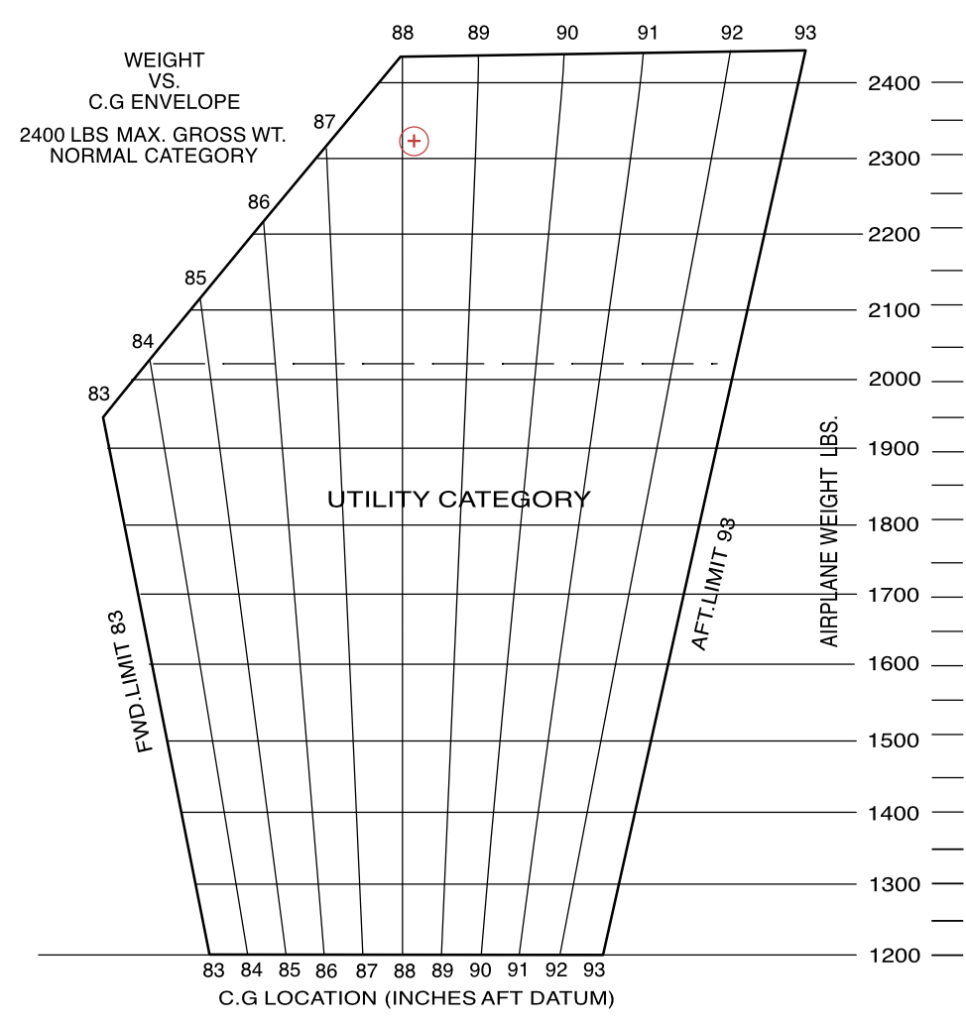
- To check against the manufacturer’s limits you will need to locate the Weight vs C.G Envelope (or equivalent table) in the POH.
- On the C.G location scale (vertical axis) locate the Takeoff Center of Gravity (88.2″)
- On the Airplane Weight scale (horizontal axis) locate the takeoff Weight (2321 lbs)
- Make a point on the graph where the two points intersect. (as shown below).
- If the point falls within the C.G. envelope, the loading meets the weight and balance requirements.
Key concepts
- Datum: A designated reference point on the aircraft, often located at the firewall, from which all distances are measured.
- Weight: The total weight of the aircraft and its contents, which must not exceed the maximum gross weight.
- Station: A location along the airplane fuselage usually given in terms of distance from the reference datum.
- Arm: The horizontal distance from the datum to the center of an object (e.g., a passenger’s seat, a fuel tank).
- Moment: The product of an item’s weight multiplied by its arm (Weight ×Arm = Moment).
- Center of Gravity (CG): The point where the aircraft would be perfectly balanced. It is calculated by dividing the total moment of all items by the total weight of the aircraft.
- Ballast: A weight installed or carried in an aircraft to move the center of gravity to a location within its allowable limits.
- Empty Weight: The weight of the airframe, engines, all permanently installed equipment, and unusable fuel.
- Basic Empty Weight: Standard empty weight of the airplane plus optional equipment / Oil / Un-drainable Fuel etc.
- Zero Fuel Weight: The weight of an aircraft without fuel.
- Maximum Zero Fuel Weight: The maximum authorized weight of an aircraft without fuel. This is the total weight for a particular flight minus the fuel. It includes the aircraft and everything that is carried on the flight except the weight of the fuel.
- Ramp Weight: The zero fuel weight plus all of the usable fuel on board.
- Useful Load: The difference between takeoff weight, (or ramp weight if applicable), and basic empty weight.
- Pilot’s Operating Handbook (POH): An FAA-approved document published by the airframe manufacturer that lists the operating conditions for a particular model of aircraft and its engine(s)
- Load Factor: The ratio of the maximum load an aircraft can sustain to the total weight of the aircraft.
- Center of Lift: The location along the chord line of an airfoil at which all the lift forces produced by the airfoil are considered to be concentrated.
- CG Arm: The arm obtained by adding the airplane’s individual moments and dividing the sum by the total weight.
- CG Limits: The extreme CG locations within which the aircraft must be operated at a given weight.
- CG Limit Envelope: An enclosed area on a graph of the airplane loaded weight and the CG location. If lines drawn from the weight and CG cross within this envelope, the airplane is properly loaded.
- Unusable Fuel: The fuel remaining after a test has been completed in accordance with governmental regulations.
- Usable Fuel: The fuel available for flight planning.
References Used in this Lesson
Aircraft Pilot Operating Handbook (POH)